

How Does A Copper Mine Bring Clean Energy
Fifty-fifty with expansions at existing mines and the ramp-upwardly of the relatively few new copper mines like Cobre Panama, Radomiro Tomic and Toquepalain, it will non be enough to meet the onslaught of demand that is coming from China as information technology continues to modernize and urbanize, and electric vehicles, which use three times as much copper every bit regular ones. In 2022 Chinese automakers sold 28 million cars. If China follows through on its promise to go 100% electric, that would mean 2,380,000,000 kilograms of copper. At the current product rate of 20 million tonnes a year, that's 119 years worth of copper! Just to produce enough copper for electric cars in Communist china.
Practise we expect 100% EV penetration? No. Only the shift to electrification of our transportation system is real, it's non going to go away or terminate. Because it's as real every bit the shift from woods to coal to fossil fuels and now to lithium. That ways massive new copper supplies are needed just for Chinese EVs, whatever the EV penetration eventually turns out to be. And retrieve there's the remainder of the world to supply for EVs, charging infrastructure, and all of copper's other uses.
Bottom line? We gotta find more copper.
'Future-facing metals'
That sentiment is clearly shared by some of the world's largest copper companies, who are doing everything they tin to expand existing mines and larn prospective new deposits, as they seek to replace their speedily depleting copper reserves and resource.
In 2022 the Chilean government canonical a $2.5 billion expansion of BHP'due south Spence copper mine – the diversified miner's 2d largest copper mine behind Escondida, the biggest copper operation in the earth.
That followed closely behind BHP's 2022 conclusion to heighten its annual exploration budget by 29%, allocating near all of its $900 one thousand thousand budget to finding new copper and oil deposits – two commodities the earth'south largest miner thinks it needs to bolster future growth. Potential acquisition targets include copper deposits in Peru, the US, Canada and Due south Australia.
In February of this year, chief executive Mike Henry said the company needs more "future-facing metals" such equally copper. Last year, BHP became the top shareholder in SolGold, an Australian miner developing the Cascabel copper-gold project in Ecuador.
Last week, BHP announced it is ramping upwardly work on the Spence mine expansion, to reach its production objective in the get-go half of 2022 (the projection has been delayed due to covid-19 restrictions).
It's interesting to note that BHP is planning to "go green" at Spence, with a focus on running the operation entirely on renewable energy by 2022. The Melbourne, Australia-based company also aims to stop drawing water from aquifers in Chile past 2030 – a reference to the bug mining companies are facing getting plenty water in the bone-dry Atacama desert of northern Chile, the base of operations of operations for several major copper and lithium mines.
The $2.5 billion expansion contemplates a concentrator constitute to increase product, and extend the life of the eolith past about xx years. The new mine volition also feature an $800 million desalination establish located in the port city of Mejillones, well-nigh 60 km due north of Antofagasta, that treats and pumps seawater at 1,000 liters per 2nd.
BHP isn't the only large mining firm taking a serious look at copper. Barrick Gold is interested in diversifying into the red metallic from the yellow. CEO Mark Bristow sees Indonesia'southward Grasberg, the second-largest copper mine in the world, equally a potential buy-out target for Barrick. The visitor already owns the Porgera mine in Papua New Guinea, which borders Indonesia to the east, with China's Zijin Mining. In May, Bristow told the Fiscal Times he was smashing to expand in Asia, despite a recent dispute with the government of PNG over a renewal of Porgera's license, which led Barrick and Zijin to shut the mine.
Meanwhile the CEO of Anglo American, another major diversified miner, indicated that Due south Africa would be a good jurisdiction to explore for base metals. "Nosotros volition explore base metals across S Africa… We are already in Zambia and other places, nosotros want to do more than in South Africa so we are looking for adjustments in legislation there," Marking Cutifani said during the 2022 Joburg Mining Indaba conference.
Copper, nickel, atomic number 82 and zinc are among the base of operations metals Anglo American is focusing its global discovery strategy in greenfield and brownfield projects.
Running out of ore
Why are major mining companies so intent on securing new supplies of copper? Quite but, they're running out of ore.
As we take reported, without new capital investments, Bolt Research Unit (CRU) predictsglobal copper mined product will drop from the current 20 million tonnes to below 12Mt by 2034, leading to a supply shortfall of more 15Mt. Over 200 copper mines are expected to run out of ore before 2035, with non enough new mines in the pipeline to have their place.
Some of the largest copper mines are seeing their reserves dwindle; they are having to dramatically dull production due to major capital-intensive projects to motility operations from open pit to hugger-mugger.
Grasberg in Indonesia, the globe's second-largest copper mine, is emblematic of the problems copper miners are facing. The mine began as a large open pit but after decades of extracting the easy-to-reach ore is gone and future production is expected to come up from a deep cave deposit known as the Deep Mill Level Zone. Copper concentrate exports have plunged dramatically as operations shift from open up pit to clandestine.
Major Southward American copper miners have also been forced to cut product. Land-owned Codelco has said it volition calibration dorsum an ambitious $xl-billion plan to upgrade its mines over the next decade, after reporting a drop in earnings, a prolonged strike at its Chuquicamata mine, and lower metals prices. The world'southward largest copper company also said it will reduce spending through 2028 by 20%, or $8 billion.
Chuquicamata is expected to see a xl% fall in production past 2022. A $5 billion expansion, moving from open up pit to hush-hush, will take five years to achieve full output of 300,000 tonnes per annum – this is not new product.
Shipments from BHP's Escondida mine took a hit in 2022 due to operations moving from open up pit to underground. The largest copper mine on the planet is expected to take until 2022 to re-gain full production, once again not new production.
These cuts are significant to the global copper market place because Chile is the world'southward biggest copper-producing nation — supplying 30% of the world's ruddy metal. Calculation insult to injury, for producers, copper grades accept declined most 25% in Chile over the last decade, bringing less ore to market place.
Country-wide protests over transit prices and perceived inequality take disrupted mining supply bondage. The social unrest, forth with a newly invigorated resource nationalism, has spooked would-be foreign investors in a country that only a few years ago was touted as an economical tiger.
Chile also has issues with water. The country's surreptitious reservoirs need to exist recharged by rainfall and snowmelt from the Andes, but a study found more water was leaving the salars (salt flats) than returning, prompting water restrictions affecting both lithium and copper mines in the extremely arid Salar de Atacama, in northern Chile. In 2022 Chile's water authority said it would double the number of areas off-limits to mining, from 30 to at least 70.
Escondida volition stop drawing fresh water from the salt flat. Instead, the huge mine will bring desalinated water from the coast, where in 2022 BHP spent $iii.4 billion on a desalination plant. Two pipelines transport water a steep iii,200m above ocean level.
Antofagasta's Zaldivar mine is nearing its mine life at 2029, and may be forced to close earlier if its water permits to draw h2o from the salar are non renewed.
A 2022 report past Moody's Investors Service said that some of the worst droughts in one-half a century accept led to tougher ecology regulations that are hiking miners' costs and risks. Among the countries with mines exposed to decreasing h2o availability are Peru, Chile, Australia, S Africa and Mongolia.
On top of all this, there is the ongoing threat of strikes at South American copper mines which every year strip out some percentage of output. In a recent article, Bloomberg reports how a confluence of factors, including copper prices at a 7-year high, productivity gains (Chile is producing at similar levels to last year with fewer workers) and weak local currencies, are swelling industry margins, emboldening unions to downwardly tools and inquire for more than pay/ benefits. Await for labor disruptions next year, when 31 contracts are due to expire in Chile, including at BHP's Escondida, hit by a 44-twenty-four hour period strike in 2022.
What about new copper mines? Surely mineral exploration companies are identifying new ore bodies, cueing upward the next generation of copper producers?
Well, they are trying. Problem is, they are having to go further afield and dig deeper to find copper at the grades needed to economically produce copper products for end-users. This usually means riskier jurisdictions that are ofttimes ruled by shaky governments with an itchy trigger finger on the resource nationalism button. Combine that with product problems and you have the makings of a supply shortage.
In fact, new supply is concentrated in just five mines – Republic of chile's Escondida, Spence and Quebrada Blanca, Cobre Panama and the Kamoa-Kakula project in the DRC. And while these mines are expected to account for 80% of base-case output increases until 2022-23, their profitability depends on the copper price staying in a higher place $v,000 a tonne, according to analysts at Bank of America Merrill Lynch.
The current copper pipeline is the lowest it's been in a century, and not improving. In 2022 Colin Hamilton, the director of commodities research at BMO Capital Markets, said that after the commitment of first copper from Cobre Panama (285-310,000t per year), BMO doesn't see the next batch of +200,000-tonnes projects until 2022-23 — "when the likes of Kamoa (501,000t per year), Oyu Tolgoi Phase 2, and QB2 (316,000t per year) are likely to offer meaningful supply growth."
Electrification 2.0
Copper's widespread utilize in construction wiring & piping, and electrical transmission lines, make information technology a key metal for civil infrastructure renewal.
The connected move towards electric vehicles is a huge copper commuter. In EVs, copper is a major component used in the electric motor, batteries, inverters, wiring and in charging stations. An boilerplate electrical vehicle contains about 4X as much copper equally regular vehicles. Electrification includes not only cars, but trucks, trains, delivery vans, construction equipment and two-wheeled vehicles like e-bikes and scooters.
The latest utilize for copper is in renewable energy, specially in photovoltaic cells used for solar power, and wind turbines. The base of operations metallic is also a key component of the global 5G buildout. Fifty-fifty though 5G is wireless, its deployment involves a lot more fiber and copper cablevision to connect equipment.
The big question is, volition there be enough copper for future electrification needs, globally? And retrieve, in add-on to electrification, copper will still be required for all the standard uses, including copper wiring used in structure and telecommunications, copper piping, and copper needed for the core components of airplanes, trains, cars, trucks and boats.
The short respond is no, not without a massive acceleration of copper production worldwide.
A recent research report from Jefferies Research LLC concluded: "The copper market is heading into a multiyear period of deficits and loftier demand from deployment of renewable energy and electric vehicles. Secular need driver in copper is electric rider vehicles as the boilerplate EV is virtually four times as copper intensive as the average ICE car. Renewable ability systems are at least five times more copper intensive than conventional ability."
President-elect Joe Biden plans a major shift away from fossil fuels to current of air and solar ability, and from gas/ diesel vehicles to EVs. In what would be a pregnant scale-up of President Obama's 2009 plan to electrify the Us transportation organization, a kind of "electrification ii.0", Biden aims to spend up to $i.7 trillion over x years on boosting renewable power and speeding introduction of electric vehicles.
Dubbed "Make clean Energy Revolution", the plan calls for installation of 500,000 electrical vehicle charging stations by 2030, and would provide $400 billion for R&D in make clean technology.
Ane of the largest manufacturers of public charging stations, ChargePoint, is targeting a 50-fold increment in its global network of loading spots past the mid-2020s. The group in which High german companies BMW, Daimler and Siemens concur stakes, aims to operate two.5 million charging points past 2025, from 53,000 in 2022. A Level ii charging station requires vii kg of copper, a straight current fast charger (DCFC) or Level 3 station uses 25 kg.
BloombergNEF forecasts by 2040 there will be a demand for 12 million charging points, each requiring about 10 kg of copper. The number of EV charging stations recently passed the ane one thousand thousand mark.
Biden has also promised a $1.iii trillion infrastructure improvement plan, including: a $50 billion investment in repairs to roads and bridges; $10 billion for transit construction in poor areas of the country; a doubling of BUILD and INFRA grants, and more funding for the US Army Corps of Engineers.
The programme includes investments in high-speed rail, public transit, bicycling, school structure, expansion of rural broadband, and replacement of pipes and other h2o infrastructure — all of which volition crave millions more tonnes of copper, along with other infrastructure metals such as nickel, zinc and aluminum.
Is this going to happen for the US? Well if information technology is, it isn't going to come cheap, as existing metal sources run dry. Across the Atlantic, the Uk authorities has fix a target of replacing all of its 31.five million cars with electrics by 2050. A team of scientists led by the Natural History Museum's caput of earth sciences, Professor Richard Herrington, took the government to task and calculated how much raw materials that number of EVs would require.
The researchers found that to build 31.v million EVs would take a jaw-dropping 207,900 tonnes of cobalt, 264,600 tonnes of lithium carbonate, at to the lowest degree vii,200 tonnes of neodymium and dysprosium, and 2,362,500 tonnes of copper — virtually 10% of global product. Simply mining the amount of raw materials required to supercede ii billion cars globally would crave four times the U.k.'s total annual electrical output.
Prof. Herrington told AutoExpress that, while there is urgency in cutting carbon dioxide emissions, "society needs to understand that in that location is a raw fabric cost of going green".
US and UK copper needs, of grade, have to exist put in context with global need for the essential base metal.
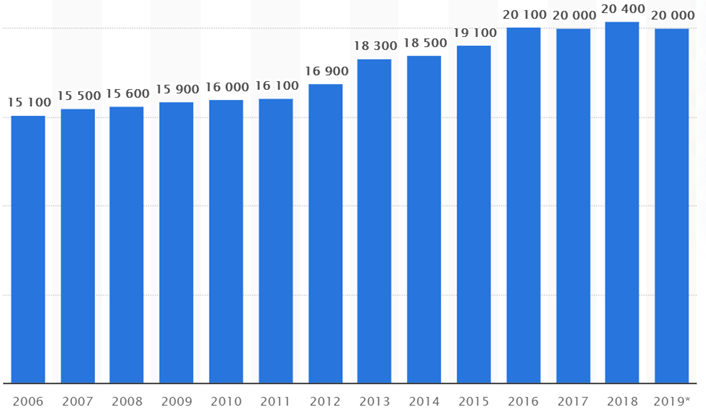
According to BloombergNEF, there are currently most 7 million electric vehicles in the earth today. By 2040, they estimate around 30% of the world's rider cars will be electric. To me that'southward a conservative and reasonable number. It ways 500 one thousand thousand EVs will be on the road in 20 years, out of a total vehicle fleet of 1.half-dozen billion. If each EV contains 85 kg of copper, that is 42,500,000,000 kg, or 42,500,000 tonnes of copper, roughly twice the electric current volume of copper produced by all of the world'southward copper mines.
But so we're clear — in 20 years, BloombergNEF says copper miners need to double the amount of global copper production (20Mt), merely to meet the demand for a 30% penetration rate of electric vehicles. That means an extra million tonnes a year, over and in a higher place what we mine at present, every year for the next twenty years! The world's copper miners need to discover the equivalent of two Kamoas, at 500,000t, each and every year, while keeping current production at 20Mt.
Recall nosotros nonetheless need to cover all the copper demanded by electrical, construction, ability generation, charging stations, renewable energy, 5G, high-speed rail, etc., plus infrastructure maintenance/ buildout of new infrastructure.
That might be another 5-7Mt. So not just is there a 20Mt increase in copper usage required for a 30% EV penetration, but another (nosotros guess) 5-7Mt increment to meet demand for all of copper'southward other applications. To keep upward, the industry volition need to find an additional ii to 3 Kamoas a year, each producing 500,000t, for the next 20 years! Think –Over 200 copper mines are expected to run out of ore before 2035, with not enough new mines in the pipeline to take their place.It'southward going to be hard plenty to go along up the electric current 20mt per twelvemonth let alone add so much more production.
Where isthisnew, and replacement, supply going to come from? When copper becomes so rare it hits $10,000 a tonne, what's going to happen to 30% EV penetration? High-speed rails? 5G? We suggest that without new copper deposits, these well-intentioned plans are in jeopardy.
Did nosotros mention Prc's Belt and Road Initiative (BRI), consisting of a vast network of railways, pipelines, highways and ports that would extend west through the mountainous old Soviet republics and s to Pakistan, Republic of india and southeast Asia?
Enquiry past the International Copper Association institute BRI is likely to increase demand for copper in over 60 Eurasian countries to 6.5 million tonnes past 2027, a 22% increase from 2022 levels.
Another report by Roskill forecasts total copper consumption volition exceed 43 million tonnes by 2035, driven by population and GDP growth, urbanization and electricity need. Remember full world mine production in 2022 was only 20Mt. In many countries information technology takes xx years to go from discovery through permitting to mining.
Copper goes critical
But there'southward a weird affair happening. The bulletin of a looming copper shortage that could bring the global electrification shift to a screeching halt, and/or brand copper so dear that only the rich tin can afford to purchase finished products fabricated from it, like EVs, isn't getting through to the mining audition, because copper is non considered a disquisitional mineral.
That term is reserved for minerals like lithium, cobalt, graphite, rare earths etc., which despite their presumed rarity, are actually fairly mutual. What makes them critical, is the fact that Due north America (and Europe) take virtually no domestic supply; without mines and a pipeline of deposits under development, and the smelters and know-how to process them, we are hopelessly reliant on strange countries. Our supply chains are vulnerable and can be exploited at will by the countries that dominate production, through policies like domestic ore beneficiation, consign restrictions, tariffs and quotas.
For years North America didn't carp to explore for these minerals and build mines. Globalization brought with information technology the mentality that all countries are complimentary traders, and friends. Dirty mining and processing? NIMBY. Permit Cathay do it, allow the DRC practice it, let whoever do information technology. This has to change, if the United states of america and Canada are to regain control of their disquisitional minerals stockpiles.
For instance, according to the US Geological Survey, of the 7 million tonnes of cobalt reserves available globally, nearly half — 3.6Mt — are in the Democratic Congo-brazzaville (DRC). The DRC is the world's leading cobalt supplier by far, in 2022 producing 100,000 tonnes of the EV battery ingredient. China locked upwards supply from the DRC with infrastructure for off-take, brings it home and refines it to sell to the earth. But there is a lot of cobalt found elsewhere. Australia has 310,000 JORC-compliant tons of cobalt only simply mined v,100t last yr. Canada has a reserve of 300,000t just only produced iii,000t. Of the 55,000 tonnes of cobalt reserves identified in the US, only 0.01% was mined in 2022, or 550t.
North America is well endowed with huge, quality rare earth deposits, plenty to supply united states with decades and decades of product. Examples include Commerce Resource' (TSXV:CCE) Ashram rare earths deposit in Quebec, and Ucore Rare Metals' (TSXV:UCU) Bokan Mountain REE project in Alaska. Graphite One (TSX.5:GPH) has an excellent graphite project in Alaska.
What we lack is processing and larger-scale manufacturing, ie. near all of the world'south mined rare earth oxides are processed in Mainland china; only very recently has REE processing started happening outside that state:
- Mountain Pass in California expects to start processing REEs by the stop of 2022.
- Lynas signed a joint venture agreement with Blueish Line Corp. to build a rare earths processing constitute in Texas.
- Saskatchewan is setting up a processing facility.
(Europe is also starting to get smart and deal with its lack of critical minerals mined and processed on the continent. The EU recently launched the European Raw Materials Alliance, a partnership of over 300 companies, business organisation associations and governments, that will focus on breaking Europe'south dependence on imports from Red china and other resource-rich countries. Analysts guess the group of 29 nations will need about 60 times more lithium and xv times more cobalt for EV batteries and free energy storage by 2050.)
Graphite is another mineral that is mined and processed under a nigh monopoly past China merely exists in big quantities elsewhere. According to the USGS, China in 2022 produced virtually 3-quarters of the world's graphite — 700,000 tonnes of the 1.1Mt full. The land indeed has a large proportion of global graphite reserves, 73Mt out of 300Mt. But China doesn't host the majority of the globe's graphite. In fact Turkey has more, 90Mt, yet final year only mined 2,000t. 25 million tonnes are held by Mozambique but the African state only produced 100,000t. Brazil has well-nigh as much graphite as China, 72Mt, but in 2022, produced simply 96,000 tonnes, about 13% of Mainland china'due south mine production. Other countries with significant graphite reserves, are Bharat (8Mt), Madagascar (one.6Mt), Mexico (iii.Mt), Tanzania (18Mt) and Vietnam (vii.6Mt).
Certainly the above-mentioned metals, and the residual of the 23 mineral commodities identifed by the United states of america Department of the Interior, are critical, in that they are all of import to the land's economic and military security. You cannot, for case, brand a lithium-ion bombardment without lithium, graphite and cobalt. But near of these metals are labeled critical because so much quantity comes from People's republic of china, Russia or the DRC. Too much supply is coming from one land and Red china is where most of the refining is done. When we showtime mining and processing here in the W, or work with our mining country allies, some degree of 'criticality' volition be removed. Why can't nosotros start mining all these minerals hither? We accept these materials in North America, South America, Commonwealth of australia and to a lesser extent, Europe. The next stride is unfettered access and the cosmos of stiff supply bondage to get these metals from mine to market.
Copper, still, is different. Arguably, the red metal is the most critical of all disquisitional metals, because of its necessity in electrification, and the fact that in that location is anbodilyshortage of copper coming.
Thereisno shift from fossil fuels to green energy without the cerise metal, which hasno substitutes for its uses in EVs (electric motors and wiring, batteries, inverters, charging stations) wind and solar energy, and 5G.
Fifty-fifty with a 30% penetration of EVs, a relatively conservative estimate, nosotros demand to observe some other 20 million tonnes per year over 20 years.
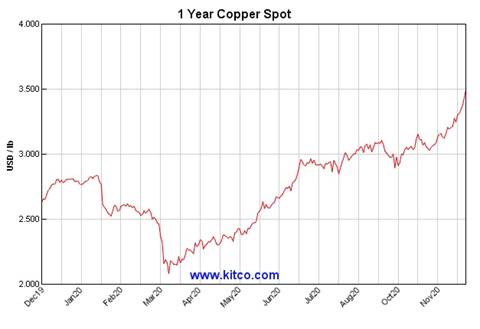
On Tuesday, Nov. 24 copper prices hit a fresh 2022 pinnacle of $3.52 per pound on the Comex in New York. The carmine metallic's best performance in seven years was on the strength of Chinese manufacturing and construction expanding at its fastest in a decade. The country's manufacturing PMI for November, seen every bit a leading indicator of copper usage, rose to 52.ane while the Caixin manufacturing PMI, which includes both large and small firms, jumped to a x-year high of 54.nine. The construction index leapt from 59.8 in October to sixty.5.
Iron ore has besides been on a tear of late. The steelmaking ingredient hit $132.xiii a tonne terminal Tuesday, a six-year high.
The numbers are then proficient, some marketplace observers are pulling up charts from the "mining supercycle". Reuters quotes Goldman Sachs predicting a return to the "structural bull marketplace" of the 2000s, when most mined commodity prices got a elevator due to demand (especially in Red china and India) outstripping bachelor supplies. In a report the investment depository financial institution states:
"Covid is already ushering in a new era of policies aimed at social demand instead of financial stability [which] will likely create cyclically stronger, more commodity-intensive economic growth, that should create the elusive cyclical upswing in demand."
Metal traders say copper is looking like it did at the offset of the '03 supercycle start, having surged this year on a wave of bullish factors including a weakened dollar, optimism over covid vaccines, a move toward low-carbon power sources, and virus-related supply disruptions in the key copper-producing countries of Republic of chile, Republic of peru and Mexico. Prices are upwards more than 70% from a mid-March low, and Morgan Stanley predicts a substantial increment next yr, to an boilerplate $seven,716 a ton ($three.85/lb) in the quaternary quarter.
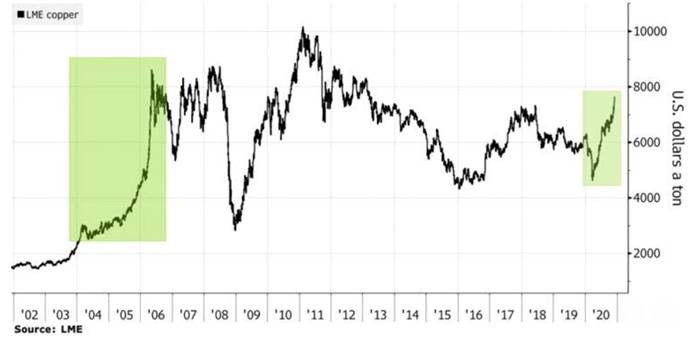
However unlike the previous supercycle, which depended on Cathay, Goldman says the next structural bull marketplace will exist driven by spending on light-green energy, for which copper is a primal ingredient:
"Spending on green infrastructure could exist as significant equally the BRIC (Brazil-Russia-India-China) investment nail of that decade while the redistributive push button in developed markets "is likely to lead to a large boost to consumer spending, comparable to the lending-fuelled consumption increase in the 2000s".
The path of least resistance to the price of copper is, imo, higher.

Source: https://www.mining.com/web/copper-the-most-critical-metal/
Posted by: forrestthaton.blogspot.com
0 Response to "How Does A Copper Mine Bring Clean Energy"
Post a Comment